
WorkSafeBC First Aid RequirementsCurrent as of October 9, 2026
OHS Regulation Schedule 3-A, accurate to October 9, 2026. The first aid requirements have not changed since November 1, 2024.
Replaces the November 2024 version. Tables 3-1 to 3-4 are reproduced from Schedule 3-A as published by WorkSafeBC on October 9, 2026.
The November 1, 2024 amendment
B.C. Reg. 132/2023 amended Part 3 of the Regulation effective November 1, 2024: Schedule 3-A was rewritten around four workplace classes, certificates were renamed, and the written assessment requirements were expanded. No amendments have been made since.
- Certificates. OFA Level 1, 2 and 3 are now Basic, Intermediate and Advanced first aid. Certificates issued before November 1, 2024 remain valid to their expiry date. The transitional provision deeming them equivalent is repealed on November 1, 2027.
- EMA licences. EMR, PCP, ACP and CCP paramedics qualify as advanced first aid attendants. An EMA First Responder qualifies as an intermediate attendant with transportation endorsement.
- Courses. Basic one day, intermediate two days, advanced ten days (includes the transportation endorsement; a one-day add-on for basic and intermediate). Certificates are valid for three years.
Determining the minimum requirement
Schedule 3-A sets the minimum from three inputs: workers present, hazard rating and workplace class. Section 3.16(1)(b) requires any further provision needed for prompt first aid and transport, determined by the written assessment.
Workers present
- The maximum number of workers at the workplace at one time during a typical shift, including supervisors, managers, regularly present office staff and the workers of every employer on site. A prime contractor counts all workers at the workplace (section 3.20).
- Shifts of consistently different size may be assessed separately.
- Part-time workers present at the same time each count as one. Dispatched workers more than ten minutes away for most of the shift count as one quarter each.
- The tables begin at two workers. A lone worker still requires a written assessment and provision for first aid and transport; Part 4 working-alone requirements (sections 4.20.1 to 4.23) apply.
Hazard rating
WorkSafeBC assigns a rating of low, moderate or high to each classification unit (CU), based on claims data and the hazards typical of the industry. The rating appears on the CU description in the annual assessment rate letter and in WorkSafeBC’s Workplace hazard ratings list. WorkSafeBC’s web pages use “medium” for “moderate”.
The assigned rating is a minimum. Work at a site that carries higher risk than is typical for the CU takes a higher rating. A lower rating applies only to a separate administrative location without the industry’s hazards, or to a prime contractor during a project stage limited to lower-hazard work, with the reason recorded in the assessment.
From the current list. High: general contracting (wood-frame; industrial, commercial, institutional and high-rise), framing, roofing, crane operation, excavation, pipeline construction, road construction, traffic control, logging, oil and gas drilling and field servicing, mining, quarries, sawmills. Moderate: electrical, plumbing, drywall, masonry, concrete placing, tree planting. Low: construction labour supply, office-based businesses.
Workplace class
Remote: an ambulance cannot travel from its station to the workplace in 30 minutes or less under normal travel conditions. WorkSafeBC links a map of BC Emergency Health Services stations on its ease of access page.
Less-accessible: any work area that cannot be safely accessed by ambulance attendants. WorkSafeBC’s examples: backcountry reached only by ATV or similar; steep or slippery slopes and embankments; elevated work with unguarded fall hazards, or areas reached only by ladders, scaffolds or temporary platforms; confined spaces, underground work and drowning hazards; roads closed to ambulances, such as a gated private road; areas with significant avalanche, landslide or flood risk; and areas requiring specialised PPE such as respirators. A ferry is a less-accessible workplace.
Under Guideline G3.16, a workplace that is not remote, with hazardous work areas but documented provisions to rescue an injured worker safely and move them to a location an ambulance can reach, need not be treated as less-accessible.
| Remote | Less-accessible | Class | Table |
|---|---|---|---|
| No | No | Class 1 | Table 3-1 |
| Yes | No | Class 2 | Table 3-2 |
| No | Yes | Class 3 | Table 3-3 |
| Yes | Yes | Class 4 | Table 3-4 |
Reading the tables
- (transport): the attendant holds the Transportation Endorsement (included in advanced certificates). A vehicle is required only where a cell lists emergency transportation.
- Kits. Personal, basic, intermediate and advanced kits follow CSA Z1220. WorkSafeBC publishes the minimum contents of each.
- Dressing station. A first aid area of at least 4.2 square metres (48 square feet) with potable water, stretcher access, signage and the equipment listed in Guideline G3.16(1). See WorkSafeBC’s first aid facilities page.
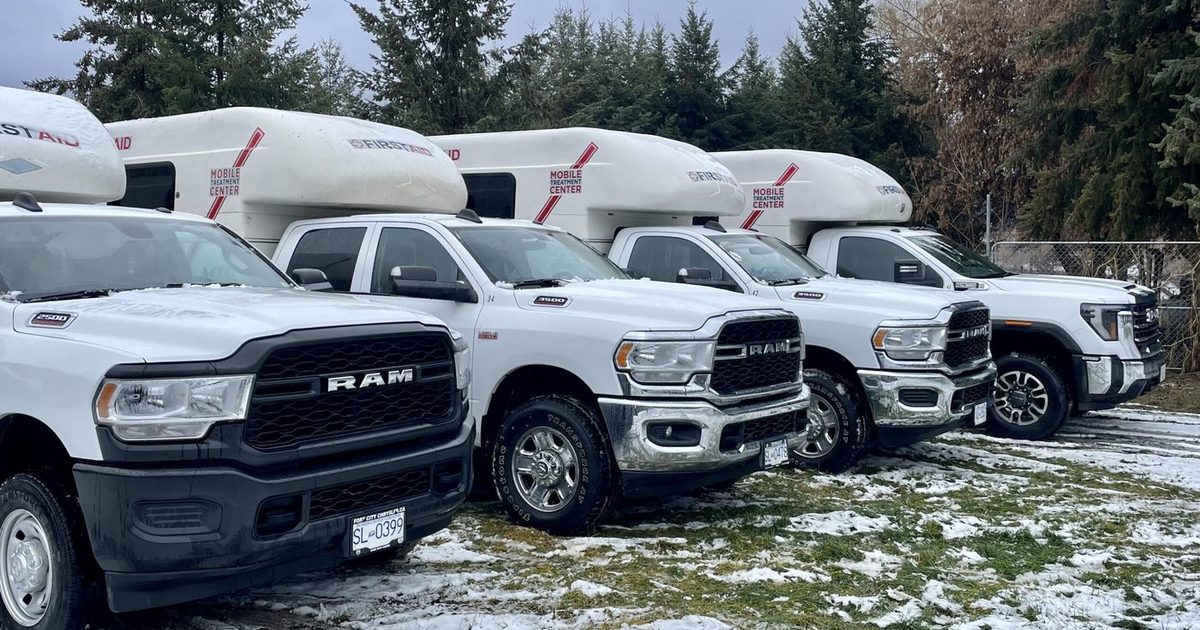
- First aid room. At least 9.3 square metres (100 square feet), with storage, counter space and a toilet in or near the room. A mobile treatment centre may serve as a dressing station or first aid room if it meets those requirements. It should not be the only first aid facility where the workplace provides overnight accommodation.
Tables 3-1 to 3-4 are reproduced from Schedule 3-A of the Occupational Health and Safety Regulation (B.C. Reg. 296/97), as amended by B.C. Reg. 132/2023 effective November 1, 2024, as published by WorkSafeBC on October 9, 2026. Tables scroll sideways on small screens.
Schedule 3-A tables
| Item | Workers present | Low hazard rating | Moderate hazard rating | High hazard rating |
|---|---|---|---|---|
| 1 | 2-9 |
|
|
|
| 2 | 10-19 |
|
|
|
| 3 | 20-49 |
|
|
|
| 4 | 50-99 |
|
|
|
| 5 | 100-199 |
|
|
|
| 6 | 200-499 |
|
|
|
| 7 | 500 or more |
|
|
|
| Item | Workers present | Low hazard rating | Moderate hazard rating | High hazard rating |
|---|---|---|---|---|
| 1 | 2-5 |
|
|
|
| 2 | 6-9 |
|
|
|
| 3 | 10-19 |
|
|
|
| 4 | 20-49 |
|
|
|
| 5 | 50-99 |
|
|
|
| 6 | 100-199 |
|
|
|
| 7 | 200-499 |
|
|
|
| 8 | 500 or more |
|
|
|
| Item | Workers present | Low hazard rating | Moderate hazard rating | High hazard rating |
|---|---|---|---|---|
| 1 | 2-9 |
|
|
|
| 2 | 10-19 |
|
|
|
| 3 | 20-49 |
|
|
|
| 4 | 50-99 |
|
|
|
| 5 | 100-199 |
|
|
|
| 6 | 200-499 |
|
|
|
| 7 | 500 or more |
|
|
|
| Item | Workers present | Low hazard rating | Moderate hazard rating | High hazard rating |
|---|---|---|---|---|
| 1 | 2-5 |
|
|
|
| 2 | 6-9 |
|
|
|
| 3 | 10-19 |
|
|
|
| 4 | 20-49 |
|
|
|
| 5 | 50-99 |
|
|
|
| 6 | 100-199 |
|
|
|
| 7 | 200-499 |
|
|
|
| 8 | 500 or more |
|
|
|
Emergency transportation
Required only where a cell lists it, which occurs only in Tables 3-2 and 3-4: from 6 workers at a high hazard rating, 10 at moderate and 50 at low. The written assessment may require transportation at any workplace where transport time warrants it.
Section 6 of Schedule 3-A requires that the transportation be capable of carrying a first aid attendant and the injured worker secured on a stretcher; have effective communication between the attendant and the operator; and be designed and equipped to secure the worker against jarring, protect against the elements and dust, maintain normal body temperature, and give the attendant adequate space to provide first aid.
Guideline G3.16(1) describes three levels:
- Emergency transportation vehicle (ETV). Any vehicle meeting the requirements above, maintained and operated under Part 17 of the Regulation and, on public roads, the Motor Vehicle Act.
- Industrial ambulance. An ETV used only for first aid and transport under the attendant’s direction, accommodating two stretcher patients, with lighting in the patient compartment and a secured roll cot.
- Mobile treatment centre (MTC). An industrial ambulance with a sink or potable water supply, 1.8 metres of headroom in the treatment area and dressing station equipment, which may serve as the dressing station or first aid room. Where the workplace is more than two hours’ surface travel from a hospital, a second transport vehicle should also be provided.
Overnight care (Schedule 3-A, section 5): where a first aid room is required and travel to a qualifying hospital exceeds two hours, an attendant must be available overnight and the room equipped for overnight care of two workers. Air transportation (section 3.17.1): where air is the primary or only method, arrangements with an air service, a compatible stretcher, a daily availability check and pilot-to-attendant communication are required.
Written first aid assessment
Section 3.16(2) requires a written assessment for each workplace covering at least: the number and locations of workers; the nature and extent of risks and hazards; the types of injuries likely to occur; barriers to first aid; and the time and methods available to obtain transportation and reach medical treatment. The assessment is prepared in consultation with the joint committee or worker health and safety representative, and reviewed within 12 months and on any significant change in operations. At a multiple-employer workplace the prime contractor conducts the assessment (section 3.20). WorkSafeBC provides an online assessment tool.
Related duties: written first aid procedures, posted at the workplace, including the location of any emergency transportation (section 3.17); drills at least annually and whenever procedures change (3.17(4)); and first aid records kept confidentially for at least three years (3.19).
Vital Safety services
Vital Safety provides basic, intermediate and advanced first aid attendants with transportation endorsement, and B.C.-licensed paramedics qualified as advanced attendants. Its Mobile Treatment Centres are industrial ambulances equipped to serve as the dressing station or first aid room, covering the transportation and facility requirements of a remote-site cell in one unit, with the required kit and an AED. MTC Rentals supplies ETVs and Mobile Treatment Centres without an attendant.
Request a quote or call (778) 721-5995.
Sources, checked October 9, 2026
- OHS Regulation Part 3, sections 3.14 to 3.21, and Schedule 3-A
- OHS Guideline G3.16, First aid assessment, and G3.16(1), Minimum requirements for first aid equipment
- WorkSafeBC: Assess your first aid requirements, Get or renew a B.C. workplace first aid certification, Emergency transportation
- Workplace hazard ratings information sheet (WorkSafeBC, current as of June 15, 2024)
The date in the title is the date this article was last checked against the Regulation.